Top Solar Heat Pump Suppliers for Global Buyers

Choosing reliable solar heat pump suppliers requires more than comparing product prices. Global buyers must examine efficiency, operating temperature, warranty terms, and after-sales support. A supplier may offer an attractive quotation, yet weak documentation can create expensive delays. Product quality matters most during cold mornings, cloudy afternoons, and heavy domestic hot-water demand.

This guide introduces leading solar heat pump suppliers for residential, commercial, and light industrial applications. It considers manufacturing experience, testing procedures, export capability, and technical service. Evidence such as performance reports, factory certifications, installation references, and verified project records deserves careful attention. Buyers should also check refrigerant choices, noise levels, controller functions, and compatibility with existing storage tanks. Small details often decide whether a system performs smoothly.

Local climate changes everything. A unit designed for mild coastal weather may struggle in a freezing inland region. Ask suppliers for real operating data, not only laboratory figures. Request clear information about seasonal efficiency, defrost cycles, spare parts, and response times. No ranking is flawless. Supplier information can change, and published claims still need independent verification. Site conditions, installer skill, and maintenance habits also influence results. Reliable decisions come from comparing evidence with practical project needs, then testing assumptions before signing a large order. The strongest supplier is not always the cheapest. It is often the one that communicates clearly, documents limitations, and supports the system after delivery.
Top Solar Heat Pump Suppliers for Global Buyers

Solar Heat Pumps: Technology, Applications, and Market Role

Solar Heat Pumps: Technology, Applications, and Market Role

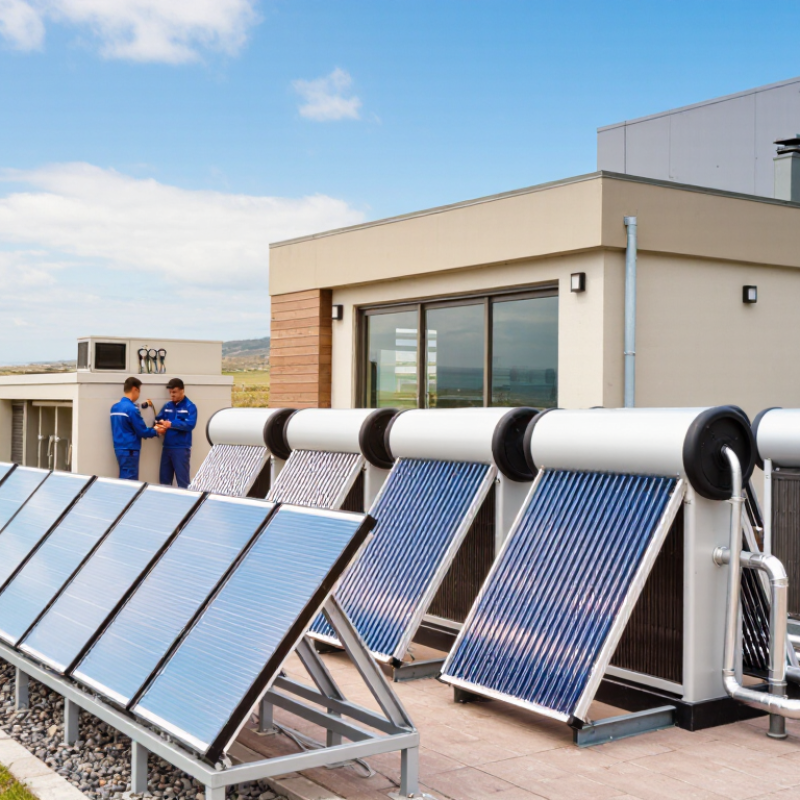
Solar heat pumps combine heat-pump technology with solar energy. Solar panels may power the compressor, while solar thermal collectors can preheat water. The heat pump then raises that energy to a useful temperature. This design reduces electricity demand, but results depend on sunlight, insulation, and operating habits.

A rooftop system might heat a 200-liter tank during daylight, then serve showers in the evening. Real projects rarely match brochure conditions.

Applications and Market Role

Their applications extend beyond homes. Hotels use them for continuous hot-water production. Swimming pools benefit from low-temperature heating. Farms can support greenhouse heating, crop drying, or livestock-water systems.

Commercial buildings may connect solar heat pumps with storage tanks and smart controls. In the wider market, these systems help reduce peak-grid pressure and improve renewable-energy use.

They are not a universal replacement for every boiler. Cold weather, limited roof space, and high initial costs still require careful planning.

Tips

Global buyers should request seasonal performance data, not only peak COP figures. Check operation at the local outdoor temperature. Review refrigerant safety, electrical requirements, water quality limits, and recognized certifications.

Ask suppliers about spare parts, commissioning, warranty terms, and technician training. Compare thermal storage size with daily demand.

A small tank may cause frequent cycling; an oversized one can waste space and money. Site measurements matter more than a polished sales sheet.

Key Criteria for Comparing Global Solar Heat Pump Suppliers

Top Solar Heat Pump Suppliers for Global Buyers

Key Criteria for Comparing Global Solar Heat Pump Suppliers

Comparing solar heat pump suppliers requires more than checking price lists. Start with system performance under your local weather conditions. Ask for measured COP data at low temperatures, not only laboratory results at ideal settings. A high COP on paper can mislead.

Review the relationship between collector area, storage volume, and heat pump capacity. For example, a small hotel may need different sizing from a rural home with two bathrooms. Request a clear heat-loss calculation and a seasonal energy estimate. Good suppliers explain assumptions in plain language. Vague sizing deserves caution.

Check component quality, operating noise, refrigerant type, and protection against frost or corrosion. Ask how the controller manages cloudy days and limited solar input. It should switch smoothly to another heat source when required. Field experience matters here. Installation manuals should include wiring diagrams, maintenance intervals, and error codes.

Evaluate local technical support before signing a contract. Can trained technicians reach the site? Are replacement parts available within weeks, not months? Examine warranty terms carefully, especially for compressors, pumps, sensors, and solar collectors. Independent certifications and documented test results improve confidence, but they do not replace local references. Speak with previous users if possible.

I would also question unusually low quotations. They may exclude insulation, commissioning, transport, or electrical upgrades. That omission can distort the real cost. One weakness in many comparisons is focusing on efficiency while ignoring repair access. A system that saves energy but frustrates technicians may perform poorly in practice.

Leading Supplier Types Across Major International Markets

Top Solar Heat Pump Suppliers for Global Buyers

Leading suppliers differ across international markets. Direct manufacturers usually offer stronger engineering control, factory testing, and volume pricing. They suit developers ordering standardized solar heat pump systems for hotels, housing projects, and industrial facilities. However, overseas buyers must verify production capacity, component traceability, and technical documentation before signing contracts.

Regional distributors provide another practical route. They often understand local import procedures, installer networks, and seasonal heating demand. In Europe, buyers may prioritize efficiency ratings, low-noise operation, and cold-climate performance. In the Middle East, high ambient temperature testing and corrosion protection deserve closer attention. Southeast Asian markets often need suppliers experienced with humidity, compact sites, and hot-water applications.

Local HVAC contractors and engineering integrators can be more valuable for complex installations. They assess roof orientation, storage sizing, pipe runs, electrical loads, and maintenance access. Some also manage commissioning and staff training. That support can prevent expensive installation errors. Still, service quality varies widely. Request project references, response-time commitments, warranty procedures, and spare-parts availability in writing. Regional procurement companies may coordinate several suppliers, but their technical depth can be uneven. Do not rely on attractive brochures alone. Field data matters more.

A supplier audit should compare seasonal efficiency, refrigerant details, control compatibility, and monitoring functions. Ask for test reports from recognized laboratories. Check whether claimed performance matches local weather conditions. One difficult truth remains: the lowest equipment price can create the highest lifetime cost. In practice, even experienced buyers sometimes underestimate maintenance access. That mistake deserves careful review before purchase.

Product Standards, Certifications, and Export Capabilities

Top Solar Heat Pump Suppliers for Global Buyers

Product Standards, Certifications, and Export Capabilities

Reliable solar heat pump suppliers treat compliance as a design requirement, not a sales attachment. Their units should meet recognized safety and performance standards, including IEC 60335-2-40, EN 14511, or equivalent national requirements. Seasonal efficiency data should come from controlled testing, not optimistic brochures. Ask for the exact test report and model number. Small differences matter.

Certifications must match the destination market and the shipped configuration. European buyers may require CE documentation, while other markets can request regional approvals, electrical testing, or refrigerant compliance records. ISO 9001 supports consistent production, but it does not prove product performance. This distinction is often missed. A certificate can also expire, change scope, or cover another factory. Verify it directly when possible.

Export capability appears in practical details. Experienced suppliers provide multilingual manuals, wiring diagrams, commercial invoices, packing lists, certificates of origin, and accurate HS classifications. They should protect outdoor units with reinforced corners, moisture barriers, and stable pallets. Container loading photos help. So do serial-number records.

Strong suppliers also explain spare-part availability, remote commissioning, warranty limits, and local service arrangements before payment. My own review standard is demanding, yet not perfect: factory audits can overlook seasonal production changes, and test conditions rarely match every household. Ask for field data from climates similar to the installation site.

Purchasing, Installation, and After-Sales Service Considerations

Top Solar Heat Pump Suppliers for Global Buyers

Purchasing should begin with climate data, not catalogue claims. The International Energy Agency reported that global heat pump sales grew 11% in 2022, while European sales rose by almost 40%. This growth increases supplier choice, but also raises comparison risks. Ask for seasonal performance data, noise levels, refrigerant details, and warranty terms. Match the heat pump with the building’s heat demand and solar generation profile. Oversizing can increase cost and reduce cycling efficiency. Ask for proof.

Installation quality strongly affects real-world performance. The installer should inspect insulation, pipe routes, electrical capacity, drainage, and local weather exposure. A solar photovoltaic system may reduce operating costs, but its output changes by season and location. The IEA’s Renewables 2024 report identifies solar power as the fastest-growing renewable electricity source, yet winter heat demand can still exceed winter solar production. Buyers should request a monthly energy simulation, not only an annual estimate. Performance varies. Commissioning records should include flow temperature, pressure, controls, and measured output.

After-sales support deserves the same attention as equipment specifications. Clarify response times, spare-parts availability, remote diagnostics, software support, and technician training. The European Heat Pump Association’s market reporting shows continued expansion across European markets, making service capacity increasingly important. A five-year warranty means little if replacement parts require long international shipping. Keep records. One practical weakness remains common: buyers often compare purchase prices but neglect maintenance access. That omission can make a technically efficient system inconvenient and expensive to operate.

Top Solar Heat Pump Suppliers for Global Buyers

Purchasing, Installation, and After-Sales Service Considerations

The chart compares representative annual global horizontal irradiation levels by market region, measured in kWh/m²/year. Higher solar availability can improve the value of solar-assisted heat-pump systems, but buyers should also verify product performance under local temperatures, installation capability, spare-parts availability, warranty terms, and long-term after-sales support. Values are rounded regional benchmarks based on Global Solar Atlas resource ranges.