What Is Tissue Tape and What Is It Used For?
Tissue Tape is a thin pressure-sensitive adhesive tape with a paper-like tissue carrier. The carrier adds flexibility while supporting clean cutting, handling, and bonding. Most versions use acrylic or rubber-based adhesives. They may be single-sided or double-sided, depending on the application.
This tape appears in retail displays, envelopes, labels, bookbinding, textile work, and light assembly. A double-sided grade can hold foam, fabric, paper, or plastic against a smooth surface. Imagine mounting a product card without visible fasteners. The result looks neat, but surface preparation still matters. Dust, moisture, low temperature, and rough textures can weaken the bond.
Industry reports show why these small tapes remain commercially important. Smithers’ The Future of Global Adhesive Tapes to 2028 identifies packaging, construction, transport, and electronics as major demand areas. Grand View Research’s Adhesive Tapes Market Size, Share and Trends Analysis Report also highlights growing use in manufacturing and converting applications. These reports discuss the broader adhesive tape market, not Tissue Tape alone. That distinction matters.
Technical performance depends on adhesive chemistry, carrier weight, liner design, and application pressure. 3M technical data sheets commonly evaluate adhesion, peel strength, temperature resistance, and aging behavior. However, one attractive specification does not guarantee real-world success. A tape can bond strongly in testing and fail on a dusty carton.
This guide explains what Tissue Tape is, how it works, and where it performs best. It also considers its limits. Sometimes, the simplest tape is not the right tape.
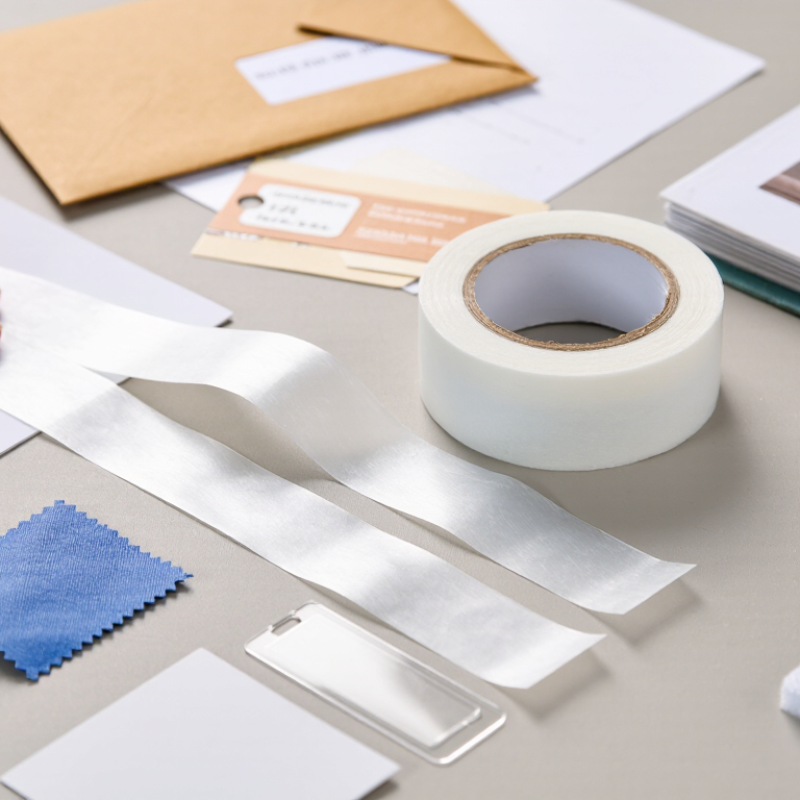
Definition and Basic Features of Tissue Tape
Tissue tape is a pressure-sensitive adhesive tape with a thin, nonwoven paper-like carrier. The carrier gives the tape flexibility and easy tearing. It also keeps the tape lightweight. Unlike plastic film tape, tissue tape can conform to curved surfaces with less visible bulk. Its adhesive layer may be single-sided or double-sided, depending on the application. Thin, but useful.
Basic features include clean cutting, fast bonding, and reasonable surface conformity. Many grades support paper, cardboard, textiles, foam, and selected plastics. However, performance changes with temperature, dust, moisture, and surface energy.
A smooth wall may accept the tape quickly. A dusty carton may not.
ASTM D3330 provides common peel-adhesion methods for pressure-sensitive tapes, helping manufacturers compare bonding performance under controlled conditions. Real performance still requires application testing.
Tissue tape is used for mounting, splicing, labeling, envelope production, insulation assembly, and temporary positioning. Double-sided versions can attach lightweight panels without visible fasteners. In packaging, its low thickness helps maintain a neat appearance.
According to Grand View Research’s 2024 adhesive tapes market analysis, the global market was estimated at approximately USD 76.8 billion in 2023. This broad market includes tissue, film, foil, and other tape structures, so the figure does not represent tissue tape alone. That distinction matters. A tape may look suitable, yet fail after several hours. Check adhesion, liner release, aging, and removal marks before routine use.
Materials and Manufacturing Process
What Is Tissue Tape and What Is It Used For?
Tissue tape is a thin adhesive tape built around a lightweight tissue carrier. The carrier may contain cellulose fibers, nonwoven fibers, or a blended structure. It gives the tape flexibility without adding much thickness. Many products use adhesive on one side, while others use adhesive on both sides.
Materials and Manufacturing Process
Manufacturing begins by preparing the tissue carrier. It must remain smooth, clean, and stable during coating. Acrylic adhesives usually provide strong aging resistance and balanced adhesion. Rubber-based adhesives can offer quick bonding and good grip on many surfaces. The formulation depends on the application, surface energy, temperature, and required holding strength.
The adhesive is mixed carefully, then coated onto the carrier with controlled thickness. Heat or air removes excess moisture and solvents. A release liner protects the adhesive before use. The coated web is laminated, cured when necessary, and slit into rolls. Small variations matter. Uneven coating can create weak edges or visible wrinkles.
Quality checks often measure peel strength, tack, shear resistance, thickness, and unwind behavior. Operators also inspect the roll for bubbles, contamination, and telescoping. In practical use, tissue tape bonds paper, labels, foam, textiles, and lightweight plastic parts. It is common in mounting, splicing, crafting, packaging, and interior assembly. However, it is not universal. Dust, oily surfaces, and low temperatures can reduce performance, even when the tape looks perfectly made.
What Is Tissue Tape and What Is It Used For? - Materials and Manufacturing Process
| Data Dimension | Typical Material or Process Data | Function and Practical Relevance |
|---|---|---|
| Product definition | Tissue tape is a pressure-sensitive adhesive tape that uses a thin, porous paper or nonwoven tissue carrier. It is commonly produced as single-sided or double-sided tape. | The tissue carrier provides flexibility, conformability, and easy hand-tear or die-cut processing while supporting the adhesive layer. |
| Tissue carrier | Creped or flat paper, cellulose-based tissue, or synthetic nonwoven tissue. Common basis-weight ranges are approximately 12–50 g/m², depending on the construction. | The carrier determines tearability, flexibility, thickness, tensile strength, and how well the tape conforms to curved or uneven surfaces. |
| Adhesive chemistry | Common pressure-sensitive adhesive families include water-based acrylic, solvent-based acrylic, hot-melt synthetic rubber, and natural or synthetic rubber formulations. | Adhesive selection affects initial tack, peel adhesion, shear resistance, temperature performance, aging behavior, and removability. |
| Adhesive construction | Single-sided tissue tape has adhesive on one side. Double-sided tissue tape has adhesive on both sides and normally includes a release liner. | Double-sided construction enables clean, concealed bonding of paper, cardboard, textiles, plastics, foams, and selected lightweight substrates. |
| Release liner | Typical liner materials are silicone-coated paper or silicone-coated polyester film. Liner thickness is often about 50–150 micrometres, depending on handling requirements. | The liner protects exposed adhesive, prevents blocking during storage, and allows the tape to be unwound and applied in a controlled manner. |
| Typical total thickness | Approximately 50–200 micrometres for many tissue tape constructions, excluding unusually thick adhesive systems or heavy release liners. | Thin construction allows discreet bonding, low joint build-up, and installation in applications with limited clearance. |
| Coating method | Adhesive may be applied by direct coating, transfer coating, gravure coating, slot-die coating, or hot-melt coating. Water-based and solvent-based systems normally require drying; hot-melt systems are applied in a molten state. | The coating method controls adhesive weight, uniformity, surface appearance, drying efficiency, and final bonding performance. |
| Typical adhesive coat weight | Approximately 15–80 g/m² per adhesive side is a practical general range; the actual value depends on substrate porosity, required adhesion, and intended use. | Higher coat weights can improve wet-out and adhesion on rough surfaces, while lower coat weights support thinner and cleaner constructions. |
| Manufacturing step 1: tissue preparation | The tissue roll is inspected, unwound, and sometimes treated with a primer or saturant to improve strength, dimensional stability, and adhesive anchorage. | Proper preparation reduces edge tearing, adhesive penetration, and carrier separation during converting or use. |
| Manufacturing step 2: adhesive coating | A controlled adhesive layer is applied to one or both sides of the tissue carrier. For double-sided tape, one adhesive side may be coated first and then laminated or coated with the second side. | Accurate coating prevents weak spots, adhesive transfer, excessive ooze, and inconsistent bonding performance. |
| Manufacturing step 3: drying or curing | Water-based and solvent-based coatings pass through heated drying zones to remove water or solvent. Some formulations may require additional curing or aging before conversion. | This step develops the intended adhesive properties and helps control residual moisture, residual solvent, and odor. |
| Manufacturing step 4: liner lamination | A silicone-coated release liner is laminated to the exposed adhesive surface, especially in double-sided constructions. | Lamination protects the adhesive and helps maintain roll stability, clean unwinding, and accurate application. |
| Manufacturing step 5: slitting and converting | Large master rolls are slit into narrower rolls, sheets, pads, discs, or custom die-cut shapes. Packaging is then selected according to storage and application needs. | Converting determines finished dimensions, dispensing convenience, edge quality, and compatibility with automated assembly equipment. |
| Key physical properties | Typical evaluation areas include thickness, peel adhesion, loop tack, static shear, tensile strength, elongation, unwind force, liner release, and dimensional stability. | Performance should be assessed using the actual bonded materials, surface condition, dwell time, temperature, and load because results vary by application. |
| Common applications | Paper and envelope assembly, bookbinding, mounting photographs and posters, label construction, textile and garment assembly, light packaging, foam mounting, and general indoor fixture work. | Tissue tape is selected where a thin, flexible, clean-looking bond is more important than high structural strength or extreme environmental resistance. |
| Surface compatibility | Often suitable for clean, dry paper, card, fabric, wood, painted surfaces, and some plastics. Low-surface-energy plastics, dusty materials, oily surfaces, and rough substrates may require a specialized adhesive or surface preparation. | Cleaning, pressure application, adequate contact area, and sufficient dwell time generally improve bonding consistency. |
| Important limitations | Standard tissue tape is not automatically waterproof, outdoor-rated, solvent-resistant, or suitable for high-load structural bonding. Paper carriers can lose strength when exposed to moisture. | The adhesive grade and carrier must be matched to temperature, humidity, load, exposure time, and required removal behavior. |
| Storage guidance | Store in the original packaging in a clean, dry environment, commonly around 15–25°C and 40–60% relative humidity when permitted by the product specification. | Avoid direct sunlight, high heat, freezing conditions, dust, and prolonged humidity exposure to help preserve adhesion and liner release. |
Note: The numerical ranges are general industry reference values. Actual specifications vary according to carrier type, adhesive formulation, coating method, and intended application.
Main Types of Tissue Tape
What Is Tissue Tape and What Is It Used For?
Main Types of Tissue Tape
Tissue tape uses a thin paper-like carrier coated with adhesive. It supports mounting, splicing, labeling, and light-duty bonding. Its structure feels flexible between the fingers, yet it can hold paper, foam, fabric, and some plastics. The correct type depends on surface energy, temperature, and required removal time.
Single-sided tissue tape has adhesive on one face. It suits labels, insulation, and temporary surface protection. Double-sided tissue tape bonds two materials together. It is common in signage, envelopes, nameplates, and lightweight assembly. Transfer tissue tape has no separate carrier. Its adhesive film transfers directly onto a surface, creating a very thin bond line. The categories overlap. That distinction is easy to miss.
Adhesive chemistry creates another practical division. Acrylic types usually offer better aging, UV resistance, and temperature stability. Rubber-based adhesives often provide fast initial grip and easy handling. Hot-melt versions can deliver strong tack without solvent coating. Grand View Research forecasts the global medical tapes market to grow at about 4.8% annually from 2024 to 2030. Smithers also identifies thinner constructions and skin-compatible adhesives as important development areas in its Future of Medical Tapes to 2028 report. These figures describe medical tapes broadly, not tissue tape alone. Testing still matters. A clean steel panel may bond well, while dusty cardboard fails quickly. Even experienced users can misjudge removal force.
What Is Tissue Tape and What Is It Used For?
Main tissue tape types compared by the number of adhesive-coated sides
Tissue tape is a thin adhesive tape with a paper-like tissue carrier. Single-sided tissue tape has adhesive on one side and is commonly used for joining, sealing, and light holding. Double-sided tissue tape is coated on both sides and is often used for mounting, laminating, and bonding materials together. Reinforced tissue tape may include fibers or scrim for improved strength, while transfer-style adhesive products use an adhesive layer without a conventional tissue carrier.
Common Uses Across Different Industries
Tissue tape is a thin adhesive tape with a paper-like, nonwoven carrier. It can be single-sided or double-sided. Its flexible structure follows gentle curves and uneven surfaces better than many rigid mounting materials. In practical work, installers often choose it when a clean bond matters more than heavy load strength. Surface preparation remains critical. Dust, oil, and moisture can weaken the bond within hours.
Packaging teams use tissue tape for carton labels, envelope flaps, gift wrapping, and lightweight inserts. Printers apply it when joining paper, foam, films, or laminated sheets. Textile manufacturers use it to hold hems, trims, patches, and temporary fabric layers before stitching. It can reduce movement during production. However, fabric texture and repeated washing need careful testing.
In electronics and appliance assembly, tissue tape may secure small components, insulation layers, or decorative panels. Interior contractors use it for trim, lightweight signage, carpet edges, and wall protection materials. Medical and personal-care products may use skin-friendly versions for dressings or wearable accessories, but adhesive safety must be verified. Not every tissue tape suits every surface. Temperature, humidity, pressure, and removal time can change performance. A short trial on the actual material is often wiser than trusting a general specification. That step is easy to skip. It should not be.
Advantages, Limitations, and Selection Factors
What Is Tissue Tape and What Is It Used For?
Tissue tape is a narrow adhesive strip used to support wound edges, secure dressings, or protect fragile skin. It is often applied after minor cuts have been cleaned and assessed. Unlike stitches, it does not enter the skin. The tape works best when wound edges meet easily and the surrounding skin is dry, intact, and free from oil.
Its main advantage is simplicity. Application is quick, removal usually causes less trauma than stronger adhesives, and the low profile feels comfortable under clothing. Some versions allow air movement and modest moisture control.
However, tissue tape is not suitable for every wound. Heavy bleeding, deep separation, infection, high skin tension, or movement across a joint can reduce its reliability. Sweat may loosen it. Sensitive skin may develop redness or itching. It can fail quietly.
Selection requires more than choosing the widest roll. Match the tape’s width and length to the wound and expected movement. Consider breathable material for humid areas and gentle adhesive for older adults or children. Flexible tape may suit elbows, but excessive stretch can weaken edge support.
Check the surface condition before applying it. A common mistake is placing tape over damp skin, then blaming the adhesive. Another is covering a wound that needs medical assessment.
If pain, swelling, warmth, discharge, or wound opening appears, professional advice is appropriate. Even careful selection has limits.

