What Is Custom Stainless Steel Coil and How Is It Used?
Custom Stainless Steel Coil is not simply stainless steel rolled into a convenient package. It is a material solution designed around a buyer’s exact production needs. Grade, thickness, width, surface finish, edge condition, coil weight, and delivery tolerance all matter. A 304 coil may suit kitchen equipment, while 316L is often chosen for marine or chemical environments. The difference can become visible as stains, cracks, or premature replacement.
Harry Brearley, the British metallurgist credited with developing stainless steel, wrote, “I have never thought that I discovered stainless steel. I have always considered that I discovered the practical application of stainless steel.” His observation remains relevant. Custom Stainless Steel Coil creates value through application, not appearance alone. A 2B finish may support practical forming, while a bright-annealed surface can improve the visual quality of decorative panels. Slit edges may fit a stamping line better than standard mill edges.
Small details matter.
Manufacturers may anneal, pickle, level, slit, or polish the coil before shipment. They can also provide heat numbers, inspection records, and dimensional reports for stronger traceability. These documents help engineers confirm that the delivered coil matches the approved specification.
Still, a perfect specification can fail when the real service environment is misunderstood. Humidity, chlorides, forming stress, and cleaning chemicals deserve careful review. Experienced buyers sometimes focus too heavily on price. That choice can create hidden costs later. This guide explains how Custom Stainless Steel Coil is produced, selected, and used across fabrication, construction, transportation, food processing, and precision manufacturing.
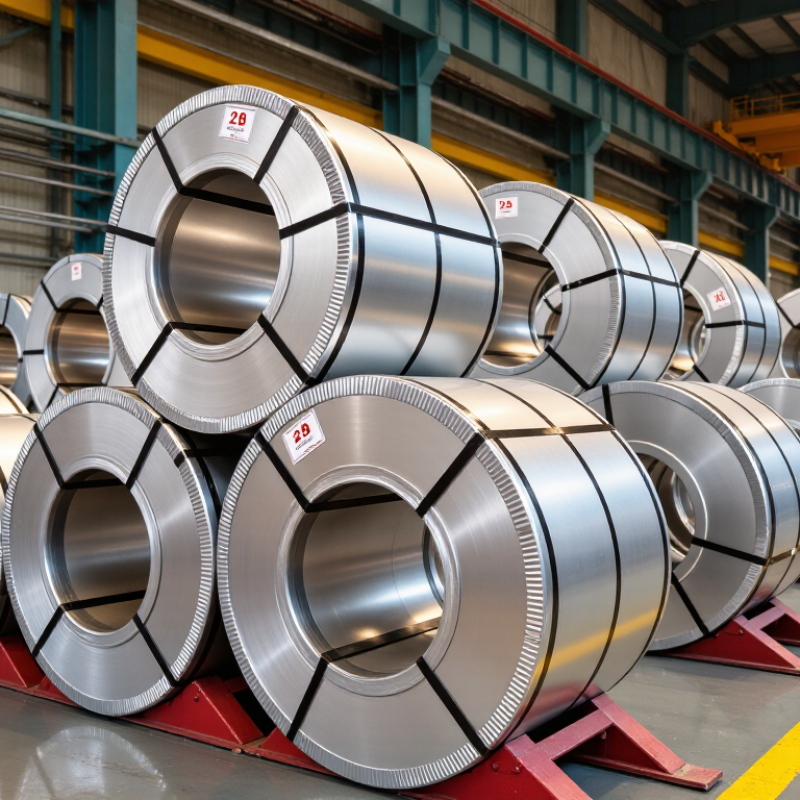
What Is Custom Stainless Steel Coil? Grades, Forms, and ASTM Standards
Custom stainless steel coil is flat-rolled stainless steel produced to specified thickness, width, edge condition, finish, and temper. It may arrive in a wide master coil or narrow slit strips. A fabrication engineer may request 0.8 mm thickness, 120 mm width, deburred edges, and a satin surface for formed panels.
Grade selection depends on the working environment. Grade 304 offers strong general corrosion resistance for kitchen equipment, enclosures, and indoor fabrication. Grade 316L performs better around chlorides, moisture, and marine exposure because of its molybdenum content. Grade 430 is magnetic and often suits decorative parts and appliances. Duplex grades provide higher strength, but forming requires tighter process control. The attractive grade is not always the practical one.
ASTM A480 defines general requirements for flat-rolled stainless products, including dimensions, tolerances, and surface conditions. ASTM A240 covers stainless plate, sheet, and strip used in many industrial applications. ASTM A666 addresses annealed or cold-worked austenitic stainless sheet and strip. These standards help buyers compare heat numbers, mechanical properties, chemical composition, and test results. A mill test certificate should match the purchase specification. Small details matter. A coil can meet its grade requirement yet fail a forming trial because of unsuitable hardness, edge quality, or surface marks. Personally, I would verify the final bend radius before approving a large production run.
How Are Coil Thickness, Width, and Tolerances Specified? Typical 0.05–6 mm
Custom stainless steel coil is produced by rolling stainless steel to a controlled gauge, then slitting or finishing it for a specific application. It may feed heat exchangers, medical housings, kitchen panels, or precision springs. The specification starts with grade, temper, surface, and dimensions. The International Stainless Steel Forum reported 58.4 million tonnes of stainless crude steel production in 2023. That scale supports many coil formats, but volume does not guarantee a suitable tolerance.
Thickness is normally stated in millimetres, such as 0.05, 0.20, 1.00, or 6.00 mm. The 0.05–6 mm range covers delicate foil-like strip through heavy cold-rolled material. Width is stated separately, often as a slit width or mill-edge width. A purchase order should identify nominal thickness, nominal width, coil inside diameter, outside diameter, weight, and winding direction. It should also state whether measurements follow ASTM A480/A480M or EN 10088-2. These standards distinguish nominal dimensions from permissible deviations. That distinction matters.
Tolerance is not one universal number. It changes with thickness, width, grade, rolling route, and edge condition. A narrow slit coil may need tighter width control than a mill-edge coil. A 0.05 mm strip also behaves differently during measurement. Temperature, burrs, and waviness can distort readings. Experienced buyers request the tolerance table, test method, sampling location, and inspection report before approval. A practical check uses calibrated micrometers across the strip, not one reading near the edge. That shortcut can fail. Engineers sometimes specify an impressive tolerance without checking the forming process.
| Specification Dimension | Typical Custom Range or Value | How It Is Specified | Typical Tolerance Consideration | Common Use or Design Impact |
|---|---|---|---|---|
| Material Form | Stainless steel strip or coil supplied in a continuous wound form | Grade, temper, surface finish, thickness, width, coil weight, and inside diameter | All dimensions should be linked to the applicable product standard and purchase specification | Enables slitting, stamping, roll forming, deep drawing, laser cutting, and fabrication |
| Typical Thickness | 0.05–6.00 mm | Nominal thickness in millimetres, for example, 0.10 mm, 0.50 mm, 1.00 mm, or 3.00 mm | Permitted deviation depends on the material standard, nominal thickness, product width, rolling process, and order condition | Thin gauges suit precision components and flexible parts; thicker gauges provide rigidity and load capacity |
| Thin-Gauge Coil | 0.05–0.30 mm | Often ordered with tighter control of thickness, burrs, flatness, and edge quality | Small absolute variations can significantly affect forming, electrical resistance, and feeding stability | Fine diaphragms, shims, medical components, battery parts, springs, and precision electronic components |
| Medium-Gauge Coil | 0.30–2.00 mm | Specified by nominal thickness plus grade, temper, surface, and width | Standard mill tolerances are commonly used unless a tighter custom tolerance is agreed | Automotive trim, appliance parts, kitchen equipment, tubing, brackets, and stamped components |
| Heavy-Gauge Coil | 2.00–6.00 mm | Specified as cold-rolled or hot-rolled product according to the required finish and mechanical properties | Thickness variation may be stated as a maximum deviation or as an applicable standard tolerance | Structural panels, industrial equipment, tanks, heavy brackets, frames, and fabricated assemblies |
| Strip Width | Commonly 10–1,500 mm after slitting; wider master coils may be available according to the mill and order | Nominal width in millimetres, such as 25 mm, 100 mm, 300 mm, or 1,000 mm | Width tolerance is normally tighter for precision slit strip and depends on thickness, slit method, and edge condition | Width determines the number of parts per strip, nesting efficiency, material utilization, and forming width |
| Length or Coil Weight | Specified as a continuous coil, total length, maximum outside diameter, or target mass | Order may state a maximum coil weight, minimum coil weight, or required linear metres | Actual weight and length vary with thickness, width, density, and allowable production variation | Must match decoiler capacity, lifting equipment, press-line loading, and customer storage limits |
| Inside Diameter | Common coil IDs include approximately 300 mm, 400 mm, 508 mm, and 610 mm | Specified as the inside diameter of the wound coil, usually together with maximum outside diameter | Coil ID must be compatible with the mandrel or payoff equipment; dimensional clearance should be confirmed | Affects line setup, coil handling, unwinding stability, and compatibility with processing equipment |
| Outside Diameter | Defined by the required coil weight, strip thickness, width, and equipment limitations | Specified as a maximum permitted outside diameter or maximum coil package size | Production and handling limits may restrict the available coil size even when the material specification is acceptable | Important for transport, decoiler capacity, warehouse space, and safe coil handling |
| Thickness Tolerance | Standard tolerance or agreed special tolerance; the exact value is not universal | Example format: nominal thickness 1.00 mm, tolerance ±0.05 mm, subject to the selected standard | Always identify the governing standard, measurement location, sampling method, and whether tolerance is symmetric or asymmetric | Controls part dimensions, press force, springback, weld fit-up, mass, and final assembly performance |
| Width Tolerance | Standard slit-width tolerance or a purchaser-defined tighter tolerance | Example format: nominal width 100.00 mm with a specified permitted deviation | Depends on nominal width, thickness, edge condition, slitting accuracy, and the applicable standard | Controls part alignment, blank size, progressive-die feeding, roll-forming setup, and edge-to-edge fit |
| Flatness and Shape | Specified by flatness limits, wave height, edge wave, center buckle, or camber requirements | May be expressed as deviation over a defined measuring length or as a maximum camber value | Requirements become more critical for stamping, laser cutting, roll forming, and automatic feeding | Good flatness reduces feeding problems, dimensional distortion, tool wear, and rework |
| Edge Condition | Mill edge, slit edge, deburred edge, or rounded edge | Order should state the required edge type and maximum permitted burr or sharpness | Slitting can create burrs; allowable burr height depends on safety, assembly, and downstream processing needs | Influences operator safety, nesting, welding, electrical insulation, and component fit |
| Stainless Steel Grade | Common families include austenitic, ferritic, martensitic, and precipitation-hardening grades | Specify the recognized grade designation, chemical composition, and required mechanical properties | Grade selection affects corrosion resistance, strength, magnetic response, formability, and weldability | Choose according to service environment, temperature, forming severity, and required durability |
| Temper or Mechanical Condition | Annealed, quarter-hard, half-hard, three-quarter-hard, full-hard, or a defined tensile-strength range | Specified by temper designation or minimum and maximum mechanical properties | Strength and elongation limits must be confirmed because temper names can vary by standard | Soft material improves deep drawing; harder material improves spring performance and dimensional stability |
| Surface Finish | Typical finishes include 2B, BA, No. 1, brushed, polished, or a customer-defined finish | Specify finish designation, roughness requirement where relevant, and protective film requirements | Surface appearance and roughness may vary by production route and inspection method | Determines appearance, cleanability, friction, reflectivity, and suitability for decorative or hygienic applications |
| Custom Processing | Slitting, edge trimming, leveling, cut-to-length, perforating, or protective film application | Define finished width, edge quality, burr limit, coil direction, packaging, and inspection requirements | Each additional operation introduces its own dimensional and surface-quality limits | Converts master coil into production-ready strip for automated manufacturing lines |
| Typical Applications | Automotive, appliances, food equipment, medical devices, electronics, construction, energy, and industrial machinery | Application specification normally combines grade, thickness, width, temper, surface, and tolerance | Critical applications may require material certificates, traceability, special testing, and tighter inspection plans | Custom coil reduces downstream preparation and helps maintain consistent production quality |
Which Grades Are Commonly Customized? 304, 316L, and 17-7 PH
What Is Custom Stainless Steel Coil and How Is It Used?
Custom stainless steel coil is produced to match a specific width, thickness, surface finish, edge condition, and temper. Service centers may slit master coils into narrow strips for heat exchangers, medical tools, kitchen equipment, or formed components. In practice, the drawing matters as much as the alloy. A 0.02-millimeter thickness variation can affect feeding and bending.
304
304 remains the most commonly customized grade because it combines corrosion resistance, weldability, and reliable forming performance. It suits indoor equipment, food-processing surfaces, and general fabrication.
316L
316L adds molybdenum, improving resistance to chlorides and many harsh environments. Its low carbon content also reduces sensitization risks after welding. However, “more resistant” does not mean immune. Crevices, salt deposits, and poor cleaning can still cause corrosion.
17-7 PH
17-7 PH serves a different purpose. After suitable heat treatment, it provides high strength, spring recovery, and useful dimensional stability. Designers often specify it for springs, washers, aerospace-related components, and precision parts. Its performance depends heavily on the selected condition, aging cycle, and forming sequence. That detail is easy to underestimate. A strip may look correct after slitting but fail after excessive forming.
Before ordering, engineers should verify chemistry, hardness, tensile properties, surface requirements, and the real service environment. Sample trials are not wasteful; they often expose an assumption the drawing missed.
How Are Custom Coils Processed? Slitting, Annealing, and 2B or BA Finishes
Custom stainless steel coil begins with a clear processing plan. The International Stainless Steel Forum reported approximately 58.4 million metric tonnes of global stainless steel production in 2023. That scale makes consistency essential, even for smaller custom orders.
Slitting divides a wide master coil into narrower strips. Operators set width, gauge, camber, and edge requirements before cutting. Sharp tooling reduces burrs, but it cannot remove every risk. Excessive tool wear may create rough edges or width variation. In practical coil work, edge inspection matters as much as dimensional inspection. A strip for stamping may need a smoother edge than one used for simple fabrication.
Cold rolling increases strength but also creates internal stress. Annealing heats the coil through an alloy-specific furnace cycle, restoring ductility and reducing work hardening. Pickling then removes oxides from the surface. The process must be controlled carefully. Too little annealing can cause forming cracks, while excessive heat may affect grain structure.
A 2B finish normally combines cold rolling, annealing, pickling, and a light skin pass. It offers a clean, subdued surface for general fabrication. BA, or bright annealed, uses controlled-atmosphere annealing to preserve a more reflective appearance. ASTM A480/A480M and EN 10088-2 provide useful finish and tolerance references. Still, “BA” alone is not precise enough. Buyers should specify roughness, reflectivity, slit width, burr limits, and inspection frequency. Surface appearance can vary between production lots.
Where Is Custom Coil Used? Food, Medical, Automotive, and Energy Applications
Custom stainless steel coil is produced to a defined width, thickness, temper, edge condition, and surface finish. These details matter when a component must fit a narrow production line. Food processors commonly use 304 or 316L coil for hygienic panels, conveyor parts, heat exchangers, and sanitary tubing. Smooth surfaces reduce residue traps, but poor welding can still create contamination risks. Practical inspection remains essential.
Medical manufacturers use precision coil for trays, tubing, brackets, and selected implant-related components. Material certificates, surface checks, and batch traceability support reliable production. The World Health Organization reports that more than 2.5 billion people need assistive products globally. That figure reflects a broader need for dependable medical equipment, although stainless steel is only one material choice. Real applications require validated grades and controlled processing.
Automotive production uses stainless coil in exhaust parts, clamps, fuel-system components, and battery protection structures. The International Energy Agency reported nearly 14 million electric car sales in 2023. This growth increases demand for corrosion-resistant parts around batteries and thermal systems. Energy projects also use custom coil in heat exchangers, electrolyzer components, storage equipment, and solar hardware. World Stainless reported approximately 58.4 million tonnes of stainless steel production in 2023. More output does not automatically mean better performance. Design errors, inconsistent forming, or an unsuitable finish can still undermine the entire application.

